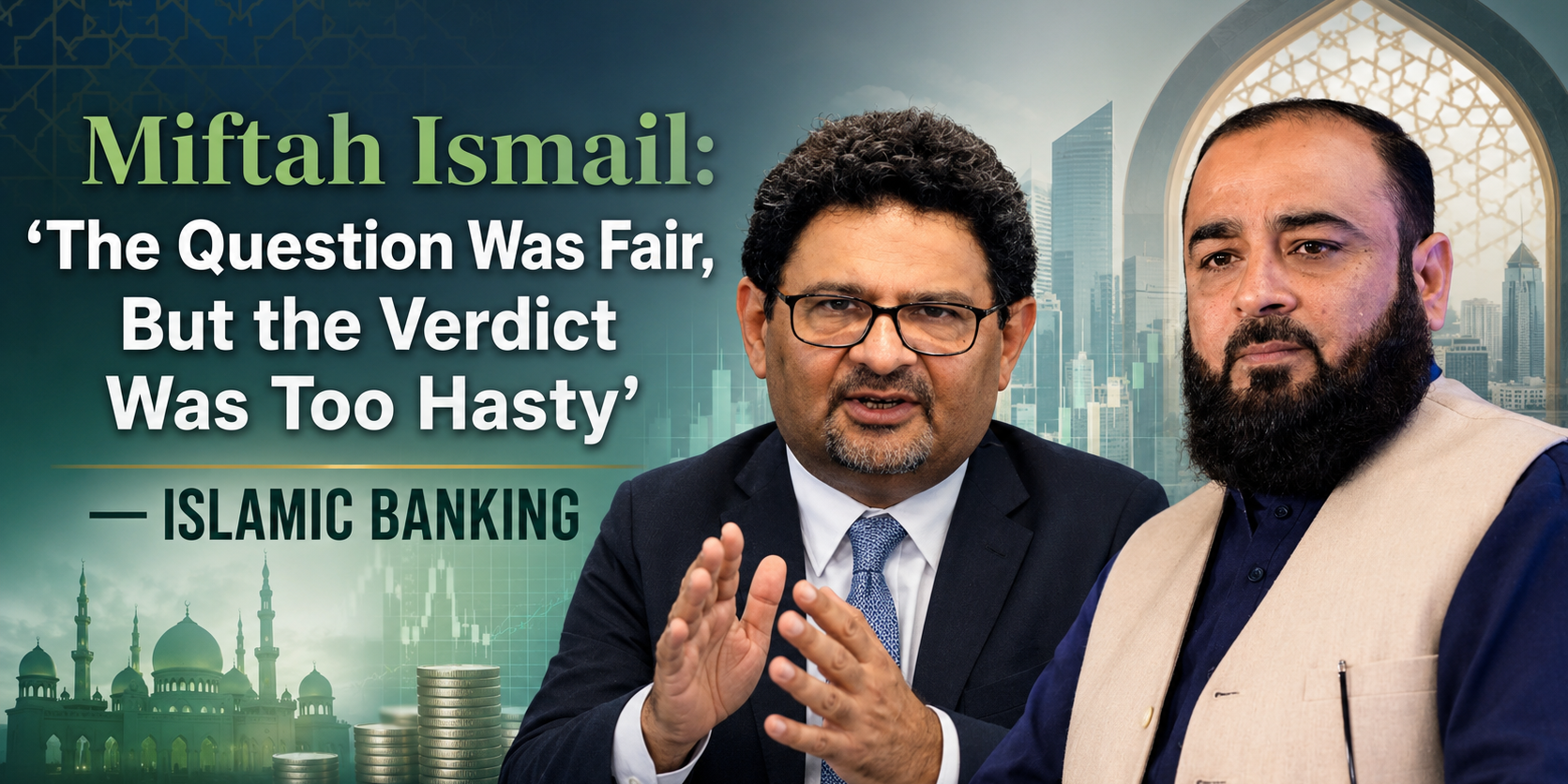
Miftah Ismail: “The Question Was Fair, But the Verdict Was Too Hasty”–– Islamic Banking
Dr. Muhammad Abubakar Siddique
School of Islamic banking and Finance
International Islamic University Islamabad
………………………………………………………………………………………….
June 07, 2026
FOR URDU VERSION – CLICK
……………………………………………………………………………………….
Miftah Ismail’s recent article, “Is Islamic banking Islamic?” published in Dawn on June 6, 2026, raises an important and timely question. As Pakistan approaches twenty-five years of modern Islamic banking, such scrutiny is welcome. Islamic banking is not above review, and its products, practices, governance, and social impact must be examined continuously. However, while the article identifies some genuine concerns, its broader conclusion — that Islamic banking is little more than conventional banking with Arabic names — appears wider than the evidence presented can justify.
A common reason for such criticism is that different Islamic banking contracts are often viewed as if they were all interest-based loans in another form. But this is not how Islamic law looks at financial transactions. A loan, a sale, a lease, and a partnership are not the same thing. Each has its own rules and consequences. A lender cannot charge a pre-agreed increase on a loan, because that is riba. But in a sale, the seller may fix a deferred price. Many objections to Islamic banking arise when different contracts—such as loans, sales, leases, and partnerships—are viewed through the same lens. This intellectual confusion ultimately leads to the mistaken conclusion that every fixed profit is interest, just as the disbelievers had claimed: “Trade is only like riba” — “They said: Trade is just like riba” (al-Baqarah 2:275). However, Allah, the Exalted, drew attention to the real distinction and declared: “Allah has permitted trade and prohibited riba” (al-Baqarah 2:275).
Similarly, a sale is different from a partnership. In a sale, once ownership and liability are properly transferred, the seller is entitled to the agreed price. In a partnership, however, profit is shared according to agreement, while loss is borne according to each partner’s investment. This distinction is important. If all Islamic contracts are judged as if they were loans, then every fixed return will appear to be interest, even when it arises from a valid sale or lease.
The central issue in Islamic banking is not merely the benchmark employed for pricing, but the juridical character of the underlying contract. The decisive question is whether the transaction is, in substance and legal effect, a loan carrying a stipulated excess, or whether it is a genuine Shariah-recognized contract, such as sale, lease, partnership, agency, or mudarabah, each of which possesses its own rules governing ownership, liability, risk, and entitlement to return. A predetermined price in a contract of sale is not riba; a fixed rental in an ijarah contract is not riba; and in murabaha, the mere fact that the deferred price exceeds the spot price does not, by itself, transform the transaction into interest. Riba arises where an unlawful stipulated increase is attached to a loan or debt, not wherever profit is realized under a valid commercial contract. The Qur’an itself draws a categorical distinction between sale and riba. To collapse every predetermined commercial return into interest would therefore obscure, if not nullify, the very distinction affirmed by the Qur’anic text.
The use of KIBOR as a benchmark is certainly a matter open to discussion, but in the view of Shariah experts, it is not by itself a decisive objection. KIBOR, in its own nature, is only a numeric number or a reference rate; it is neither halal nor haram in itself. The Shariah ruling depends on the contract in which it is used, the purpose for which it is used, and the manner in which it is applied. If it is used to stipulate an increase over a loan, it clearly becomes a means of riba. However, if it is used merely as a benchmark for determining the price in a genuine sale or the rent in a genuine lease, then the resulting profit or rent remains permissible and halal, provided that all the Shariah conditions of the relevant contract are properly fulfilled.
For the satisfaction of ordinary Muslim customers, it is certainly said that Pakistan should move toward independent Islamic benchmarks that better reflect real-sector activity, sukuk returns, rental indices, asset-based profits, and Shariah-compliant financial indicators. However, this also raises a very important and serious question: can a single uniform rate truly establish economic and financial justice for pricing and profit determination across all types of contracts, despite their different legal structures, risk profiles, asset bases, and commercial purposes?
In the interest-based system, a single benchmark such as KIBOR functions more easily because the entire structure is essentially built around one contract: the loan. Islamic finance, however, is not based on one single contract. It consists of different contractual forms, such as sale, lease, partnership, agency, mudarabah, salam, istisna‘, and others. Each of these contracts has its own legal nature, risk profile, pricing logic, and basis of entitlement to profit. In such a diverse contractual framework, the idea of one uniform “Islamic profit rate” for all products is itself open to serious reflection. Can one rate truly do justice to all these different contracts? It neither works within the contemporary interest-based capitalist framework, nor would it work under a purely Islamic economic framework either. Expecting one uniform rate to serve all Islamic financial contracts is like expecting an elephant to participate in tree-climbing competition and win: the standard itself does not suit the nature of the subject being judged. This is precisely why, within the current interest-based framework, the deeper question of economic justice remains largely unanswered, even with the existence of Islamic finance. This aspect deserves careful thought. For a more detailed discussion on this point, see my related blog post here – Click.
Let us assume, for the sake of argument, that Islamic banks should develop their own Islamic benchmark. The point, however, is that such a benchmark cannot realistically be developed by individual Islamic banks alone. This is primarily the responsibility of the regulator, especially the State Bank of Pakistan, in consultation with Shariah scholars, Islamic banks, market experts, and other relevant stakeholders. The regulator may work toward a credible, practical, and gradual Islamic benchmark, though even such a benchmark may not fully capture the justice and diversity required by all Islamic contracts. Until a comprehensive and formally accepted alternative benchmark is available, the use of KIBOR merely as a pricing reference under the shadow of the existing capitalist and interest-based financial system does not, by itself, render Islamic banking transactions riba-based. The Shariah ruling will still depend on the nature, structure, and conditions of the specific contract in which that benchmark is used.
In sale-based contracts, such as murabaha, there is no Shariah problem in using KIBOR merely as a benchmark for pricing the product, provided that the sale is genuine, the asset is owned by the bank before sale, the price is fixed, and the relevant Shariah conditions are fulfilled. In such cases, KIBOR is only a pricing tool; it is not the legal cause of the bank’s entitlement to profit. A trader may determine a deferred sale price by considering cost, inflation, market conditions, business risk, and prevailing commercial rates. A lessor may also determine rent by looking at market indicators. The permissibility of the transaction depends on the validity of the sale or lease, not on the mere fact that a benchmark has been consulted.
However, the same reasoning cannot automatically be applied to shirkah-based contracts. In musharakah, the rules are different. Profit and loss treatment is governed by partnership principles, not by sale principles. Profit may be shared according to an agreed ratio, but loss must be borne strictly in proportion to capital contribution. Moreover, where an Islamic bank practically acts as a silent partner and does not actively participate in the management of the business, its entitlement to profit should normally remain aligned with its investment share. Therefore, in running musharakah, there is no real need to use KIBOR as the benchmark for determining the bank’s profit share. The more appropriate Shariah benchmark in such a case is the investment share and the actual partnership arrangement, not KIBOR.
This is one reason why running musharakah deserves serious review. I have myself written in the past that running musharakah, as practiced in some cases, involves Shariah and operational concerns. If a product is called musharakah but its actual profit calculation, loss treatment, monitoring mechanism, risk participation, and business linkage do not properly reflect the requirements of musharakah, then such a product should be reviewed and reformed. Islamic banking should not defend every product merely because it carries an Islamic name. At the same time, it is not fair to use one problematic product as the basis for rejecting the entire Islamic banking industry. Islamic banking is not confined to running musharakah. It includes murabaha, ijarah, diminishing musharakah, salam, istisna‘, mudarabah-based deposits, wakalah structures, sukuk, takaful, Islamic liquidity management instruments, and other modes. Each product must be examined separately according to its own contractual structure, documentation, execution, Shariah requirements, and regulatory treatment.
The example of istisna‘ referred to in Mr. Miftah Ismail’s column also needs to be carefully understood. In Islamic jurisprudence, istisna‘ is not a simple contract for buying and selling an already existing commodity. Rather, it is a contract under which one party orders another to manufacture, construct, process, or prepare something according to agreed specifications. Therefore, if the transaction is merely the purchase and sale of cotton as an existing commodity, the contract of istisna‘ does not arise in the first place, and Islamic banks do not normally treat such a transaction as istisna‘. However, if the arrangement is to prepare, process, or manufacture cotton bales according to specified requirements, then istisna‘ may be relevant.
Mr. Miftah Ismail is correct to say that once an istisna‘ contract has been concluded, the agreed price should not be changed merely because the market price of cotton has gone up or down. This is, in fact, the very principle of Shariah in sale-based contracts: after a valid contract has been executed on an agreed price, neither party has the right to alter that price unilaterally. His remarks give the impression that he may have come across a transaction in which the price was allegedly changed after the contract had been concluded. If such a case exists, it should certainly be examined on its own facts. But the column does not provide any clear evidence or specific transaction to establish this claim. Hence, this example cannot fairly be used to question the validity of istisna‘ as a Shariah contract, nor can it serve as a basis for rejecting Islamic banking in general.
The allegation that Islamic banks do not actually buy or sell assets and merely create paperwork is serious. If, in a particular transaction, a bank does not acquire ownership, does not assume liability, does not bear asset risk, and merely creates documents to disguise a loan, then that transaction is not acceptable from a Shariah point of view. But such a case would represent a failure of implementation, supervision, or governance; it would not, by itself, refute the Islamic banking model. The correct response is stronger Shariah governance, meaningful asset ownership, real risk transfer, effective Shariah audit, better documentation, and stricter regulatory enforcement.
The article further suggests that Islamic banks have no downside when clients suffer losses. This statement also requires qualification. In a sale-based mode such as murabaha, once a genuine sale has taken place, the seller is entitled to the agreed deferred price even if the buyer’s business later suffers a loss. This is not riba; it is the legal consequence of a sale. If a trader sells goods on credit, the buyer’s subsequent business loss does not automatically reduce the sale price. By contrast, in a partnership such as musharakah, profit must be shared according to agreement and loss must be borne according to capital contribution. Therefore, sale-based modes and partnership-based modes cannot be judged by the same rule. Expecting every Islamic banking product to operate like musharakah is itself a conceptual mistake.
This does not mean that Islamic banking should remain satisfied with its present state. Far from it. The industry must move closer to real trade, asset ownership, entrepreneurship, risk sharing, fairness, and social impact. More genuine musharakah and mudarabah products should be developed. SME financing, agriculture financing, venture financing, Islamic microfinance, waqf-linked financing, and social finance deserve greater attention. Islamic banks must also improve transparency in profit distribution, strengthen depositor confidence, and ensure that customers do not feel that choosing Islamic banking means accepting unnecessary financial disadvantage.
The issue of late payment penalties also deserves careful handling. Islamic banks are not allowed to treat such charges as their income. Where such charges are imposed, they are generally meant to discourage willful default and are transferred to charity rather than retained as bank profit. This is materially different from conventional penal interest, which becomes income for the lender. Nevertheless, the Qur’anic instruction to grant respite to a debtor in genuine hardship must remain central. Islamic banks must carefully distinguish between a willful defaulter and a genuinely distressed debtor.
The article’s comparison between riba and wine is powerful, but the conclusion drawn from it needs refinement. It is true that riba remains prohibited even if it is given another name. No scholar would disagree with that. But the relevant question is whether a particular transaction is actually riba or whether it is a valid sale, lease, or partnership. If it is merely a disguised loan with stipulated excess, it must be rejected. But if it is a genuine Shariah-compliant contract fulfilling the conditions of ownership, liability, risk, and contractual obligation, it cannot be dismissed merely because its financial outcome resembles conventional financing in some respects.
The balanced conclusion is that Islamic banking should not be rejected because of some procedural, managerial or specific transaction level issues. It is a developing institutional effort to move from an interest-based system toward Shariah-compliant finance within a predominantly conventional and highly regulated economic environment. Its shortcomings should be identified honestly, but its genuine contractual foundations and achievements should also be recognized. The way forward is not rejection; it is reform: proper Islamic banking Act is essential, stronger governance, better benchmarks, more authentic risk-sharing products, greater transparency, and a clearer commitment to the ethical and socio-economic objectives of Islam.
At the same time, it must be acknowledged that the State Bank of Pakistan has played a significant and positive role in the promotion, regulation, and institutional development of Islamic banking in Pakistan. Through its Shariah governance framework, licensing policies, regulatory guidelines, standardization efforts, and gradual encouragement of Islamic banking windows and full-fledged Islamic banks, SBP has provided the necessary supervisory and legal environment for the industry to grow. However, as the industry expands and as Pakistan moves toward the constitutional objective of eliminating riba, SBP is also expected to place even greater focus on substantive Shariah compliance, product authenticity, independent Islamic benchmarks, effective Shariah audit, and the gradual reduction of unnecessary resemblance with conventional banking practices. In this regard, academic institutions can also play an important supportive role. The School of Islamic Banking and Finance (SOIBF), International Islamic University Islamabad, is already producing trained human resource in Islamic banking and finance at BS, MS, and PhD levels.
SBP may therefore consider closer collaboration with SOIBF for research, policy input, capacity building, Shariah compliance training, product review, and the development of more authentic Islamic banking practices. A fair assessment should thus recognize both the constructive role SBP has already played and the continuing need for deeper institutional collaboration to make Islamic finance in Pakistan more credible, authentic, and aligned with its true Shariah objectives.
May Allah guide and bless all sincere efforts toward a truly riba-free, just, and a System based on the principles of Islamic Economics in Pakistan.
Āmīn, bi-jāh al-Nabī al-Karīm al-Amīn ﷺ.
Citation:
Siddique, M. A. (2026, June 7). Miftah Ismail: “The question was fair, but the verdict was too hasty”––Islamic banking. IslamicFina. https://islamicfina.com/is-islamic-banking-islamic/