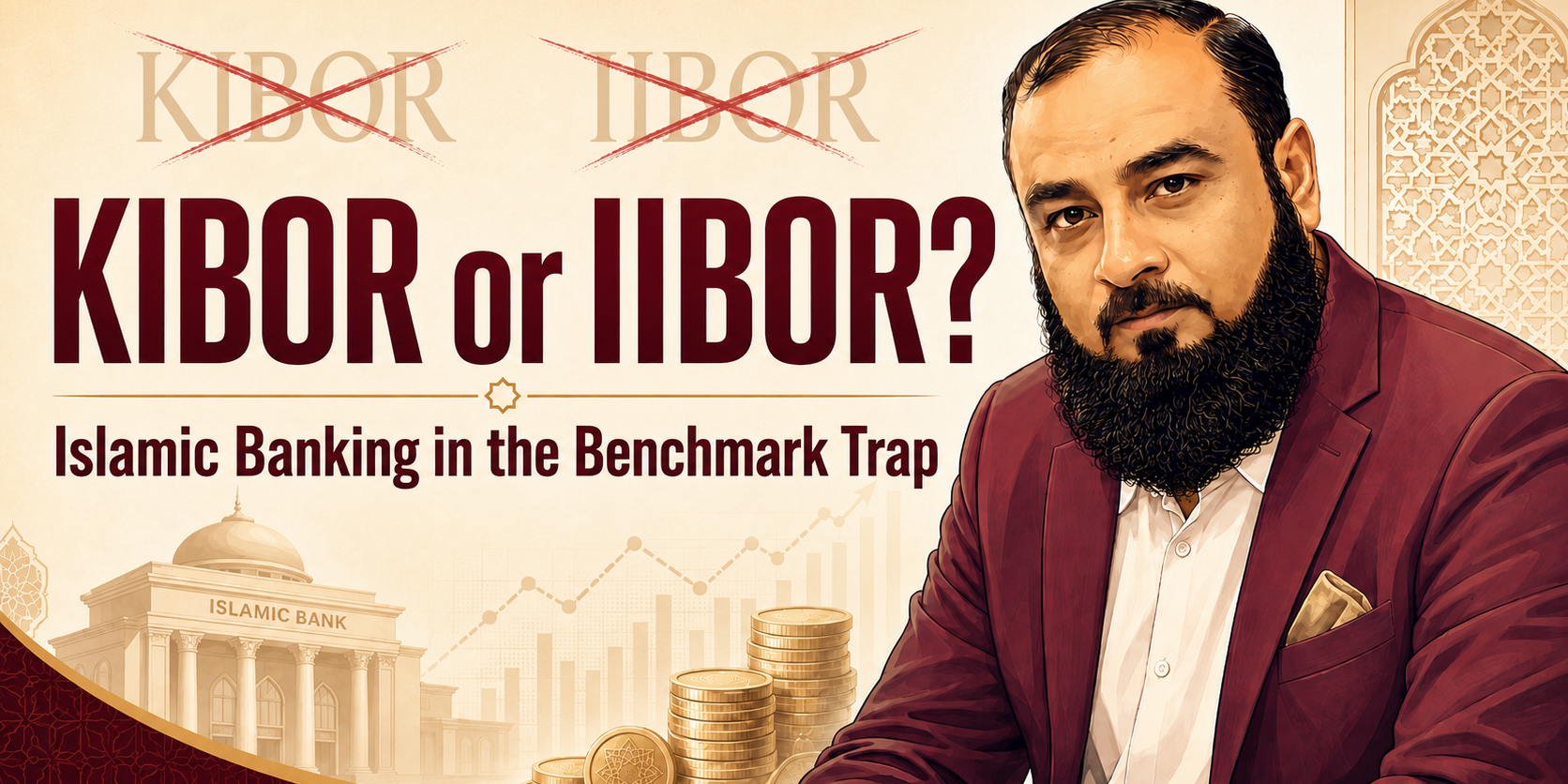
“KIBOR or IIBOR? Islamic Banking in the Benchmark Trap”
……………………
Dr. Muhammad Abubakar Siddique
School of Islamic banking and Finance
International Islamic University Islamabad
………………………………………………………………………………………….
June 10, 2026
FOR URDU VERSION – CLICK
……………………………………………………………………………………….
Imagine a man selling his product in a crowded market. A buyer asks the price. The seller pauses for a moment and gives a strange answer:
“I will take the same profit on this item that my friend earned last year in a partnership business.”
The buyer is naturally puzzled. What does a partnership business have to do with the price of this product?
Now imagine another scene. Two people enter into a business partnership. When they begin to discuss the profit-sharing arrangement, one partner insists:
“I want exactly the same percentage of profit that a trader earned by selling his goods on a cost-plus basis.”
Again, the demand sounds odd. It feels unnatural. Why? Because a sale and a partnership are not the same contract. They do not share the same legal foundation, risk structure, liability, or source of profit.
In a sale, profit becomes fixed once the price is agreed. In a partnership, profit depends on the actual result of the business. Loss remains possible. Risk is shared. The entitlement to profit emerges from participation in a real venture. So how can one contract become the benchmark for another? This simple example opens the door to a much larger question in Islamic finance: can different Islamic contracts, each with its own legal and economic nature, be fairly measured by one uniform profit rate?
One Rate Does Not Fit All
Islamic finance is not built on one contract. It is built on a family of contracts. Sale, ijārah, mushārakah, muḍārabah, salam, istiṣnā‘, agency, and sukuk structures all have different legal realities. Each contract has its own subject matter, risk, liability, ownership rules, and basis of entitlement to profit.
A sale is not a loan. A lease is not a partnership. A partnership is not murābaḥah. A muḍārabah is not ijārah. These differences are not technical decorations. They are the very substance of Islamic commercial law.
To force one rate on all of them is not natural. It is not economically fair. It also weakens the spirit of Islamic contracts. Now apply this principle to modern Islamic banking. We often hear that profit in Islamic banking products is determined with reference to KIBOR — the Karachi Interbank Offered Rate. Immediately, some voices respond: “KIBOR is an interest rate. It is haram.” This objection should not be dismissed casually. It raises a real concern. But before we properly understand the issue, the debate is often redirected. We are told: “If KIBOR is a problem, then create an Islamic profit rate. Create IIBOR.”
At first glance, this appears to be a reasonable solution. But we need to stop here.
The real question is not simply whether we should replace KIBOR with IIBOR. The real question is whether Islamic finance should remain trapped in the idea of one central rate in the first place?
When Does a Number Become Interest?
Why is KIBOR called an interest rate?
If we examine the matter carefully, KIBOR itself is only a number. A number, by itself, is neither lawful nor unlawful. It becomes part of riba when it is attached to a loan or debt as a stipulated excess over the principal. This is the basic Shariah point. If an additional amount is made conditional on a loan or debt, that excess is riba.
In the conventional financial system, the foundational contract is the loan. Financial products are largely structured around it. Money is advanced, and the lender expects a predetermined return. KIBOR functions within this system as a numerical measure of that return. This is why it is known as interest rate.
But what if the same number is used only as a pricing reference in a genuine Islamic sale?
The legal foundation changes. The number is no longer charged as an excess on a loan. It is used as a pricing reference in a sale or lease. If the contract is real, and ownership, risk, liability, possession, and other Shariah requirements are properly fulfilled, the mere use of KIBOR as a reference does not automatically make the contract interest based.
The ruling follows the reality of the contract, not the name of the numerical reference.
However, this point needs an important clarification. The present transitional situation cannot be ignored. Islamic banking is operating within an existing interest-based legal and regulatory environment. Therefore, KIBOR is used merely as a numerical pricing reference which is allowed. However, this is a transitional necessity, not an ideal principle or a permanent destination.
Now consider the proposed alternative: IIBOR, an Islamic Interbank Offered Rate. Suppose it is developed by Islamic institutions and approved by Shariah boards. The question remains: what makes it different in substance?
If someone asks whether IIBOR can be charged on a loan as a stipulated increase, the answer is clear. It cannot. If charged on a loan in that manner, this Islamic profit rate would also become riba.
So the deeper question arises: who has framed the debate in such a way that we are made to choose only between KIBOR and IIBOR?
When the Question Itself Becomes the Trap
Capitalism does not merely shape markets. It shapes the ideology through which we understand markets. It confines imagination. It tells us: either accept the existing benchmark, or create a similar benchmark with an Islamic name. Once we accept this framing, our intellectual energy remains trapped within the same circle. Scholars write papers. Seminars are held. Technical models are proposed. Institutions conduct debates whether IIBOR is better than KIBOR. Yet the deeper question remains untouched:
Does Islamic finance actually need one central profit rate at all?
This is the real trap.
A familiar moral example may help. A teacher enters a classroom and asks the students:
“A train is coming on the track. Ahead, there are two tracks. On one track stands an old man. On the other stands a child. You have the lever in your hand. Whom will you save?”
Immediately, students begin to argue. Some say the child should be saved because he represents the future. Others say the old man’s life is equally sacred. But very few stop to ask: why has stopping the train been excluded from the question? Why must we assume that changing the track is the only possible solution? Is the question itself morally valid?
The deeper problem is not only which option is chosen. The deeper problem is that the question has already restricted the moral imagination of the students. It trains them to choose within a closed frame, instead of questioning the frame itself.
Training people to think within such closed moral choices—what is this, if not a training in circumventing higher moral values? This kind of mental conditioning is central to the larger objectives of the capitalist system.
The same happens in Islamic finance. We are given two options: KIBOR or IIBOR. We then spend our energy debating which one is more Islamic. But we forget to ask a more fundamental question:
Does Islamic finance need one universal benchmark at all?
The Spirit of Islamic Contracts and Economic Justice
The real problem is not merely KIBOR versus IIBOR. The real problem is the intellectual mirage through which Islamic finance is sometimes understood.
Islam does not judge contracts by their outward names alone. It looks at their reality. It asks: what is the subject matter? Who owns the asset? Who bears the risk? Who carries the liability? What is the cause of profit? What are the consequences of the transaction for human conduct and social life?
This is where Islamic finance differs at its roots from a purely interest bearing loan-based Institutional System (IBLIS).
A true Islamic contract is not only a legal form. It is also a moral relationship. It creates trust between strangers. It links entitlement to responsibility. It connects profit with ownership, risk, effort, usufruct, or enterprise. It should reduce exploitation, not formalize it. It should support real economic activity, not merely produce paper gains.
The purpose of Islamic contracts is not merely to make finance technically permissible. Their deeper purpose is to build a moral economy: one in which trade, cooperation, partnership, fairness, and social welfare are strengthened.
When a single benchmark begins to dominate the entire pricing logic, this moral and relational spirit becomes weak. The focus gradually shifts from contractual justice to securing a predetermined financial return. The diversity of contracts is flattened. The logic of IBLIS silently returns through the back door.
This is why the issue is not only legal. It is also economic and ethical.
If KIBOR has not prevented economic injustice, why should we assume that IIBOR alone will do so? If the same rate-based imagination remains, the problem remains. A new label cannot cure an old disease.
A Single Rate Destroys Contractual Diversity
In IBLIS, millions of loan contracts may differ in size, duration, and borrower profile, but their legal nature is essentially the same: loan. This is why a single interest-based benchmark can operate across them. Islamic finance is different by design. It is not one contract repeated in different forms. It is a plural system of contracts. Each contract has its own legal personality and economic logic. If IIBOR is introduced merely as a central profit rate for all Islamic products, it may reproduce the same injustice and concentration of wealth associated with conventional benchmarks. It may allow Islamic finance to change its vocabulary while keeping the same inner architecture.
This is not the maturity of Islamic finance. It is conventional replication with Islamic terminology.
The real challenge is not to Islamicize a benchmark. The real challenge is to liberate Islamic finance from benchmark captivity.
The Real Purpose of Islamic Finance
Why did Islam prohibit riba?
Not because a number is unlawful in itself. Riba is prohibited because it separates capital from real risk, labour, ownership, and productive activity. It allows money to claim a guaranteed increase merely because time has passed over a debt. It protects the return of capital while transferring risk and pressure to the weaker party.
This structure deepens inequality. It strengthens the position of capital owners. It creates a financial culture in which wealth can grow without genuine enterprise, shared risk, or real economic contribution. Islam offers a different path. It does not replace interest with an Islamic-looking interest. It seeks to eliminate riba and the mentality that gives birth to it. It replaces debt-based extraction with trade, justice, cooperation, partnership, charity, zakat, waqf, qard hasan, and real economic activity.
The cure for riba is not another rate. The cure is removal of riba completely and build an Economic castle on the solid foundations of Islamic Economics.
The Prophetic guidance gives us a profound example. When superior-quality dates were brought to the Prophet Muhammad ﷺ, and he was informed that they had been obtained by exchanging two measures of ordinary dates for one measure of superior dates, he declared it riba. But he did not stop at prohibition. He guided the people to a real market process: sell the ordinary dates first, then use the money to buy the superior dates.
This guidance is deeply meaningful.
Islam did not merely close a prohibited form. It redirected economic behaviour toward genuine trade. The original exchange allowed gain through a direct unequal exchange of ribawi items. Such forms could open the door to artificial transactions (speculation) in which marginal gains are earned without genuine trade or productive activity.
Islam wants economic activity to have substance. It wants profit to arise from real exchange, real ownership, real risk, and real benefit to society.
This lesson is directly relevant to the modern debate. A movement from KIBOR to IIBOR alone is not enough if the underlying imagination remains IBLIS and rate-centered even it is IIBOR.
What Do We Actually Need?
This does not mean that Islamic finance needs no indicators, references, or regulatory frameworks. It certainly does. Modern banking cannot operate without transparency, disclosure, market information, and pricing tools. But Islamic finance does not need one central profit rate that dominates all contracts. It needs contract-based pricing frameworks.
- For sale-based transactions, pricing should consider the asset, cost, market price, payment period, ownership risk, delivery risk, and trade custom.
- For ijārah, pricing should consider usufruct, rental market, duration of use, maintenance, depreciation, ownership risk, and the actual benefit delivered to the lessee.
- For mushārakah, pricing should be linked with capital contribution, management role, business risk, actual performance, transparent accounts, and real profit and loss.
- For muḍārabah, the focus should be on capital, the expertise of the muḍārib, the nature of the business, expected risk, and the profit actually earned.
- For sukuk, the framework should be based on asset-backed or asset-based returns, the nature of the underlying asset, cash-flow generation, ownership structure, risk allocation, and market discipline.
- For salam, istiṣnā‘, and other contracts, separate Shariah-based and economically sound pricing principles should be developed.
This approach is more difficult than one benchmark. It requires research, data, regulation, Shariah expertise, accounting standards, legal refinement, and institutional courage. But it is closer to the spirit of Islamic economics.
A convenient system is not always a just system. Islamic finance must choose justice over convenience under the umbrella of Islamic Economics.
The Role of Regulators and Institutions
The regulator, especially the State Bank of Pakistan, has an important role in this regard in Pakistan. Its contribution to the growth of Islamic banking should be acknowledged. Islamic banking has provided a lawful and practical alternative within a difficult conventional environment. It should not be discouraged or dismissed.
But the next phase must go beyond growth in numbers. It must focus on depth, quality, and Shariah substance and more on the foundations of Islamic economics.
The task is not merely to introduce one Islamic profit rate. The task is to develop transparent, practical, and Shariah-compliant pricing frameworks for different Islamic contracts.
This work cannot be done by bankers alone. It requires Shariah scholars, economists, accountants, legal experts, regulators, industry representatives, and universities. Islamic finance will mature only when it moves beyond replication and develops its own contractual, ethical, and economic architecture.
Breaking Free
Today, Islamic finance stands at a crossroads. One path keeps us inside the cage of “KIBOR or IIBOR.” It asks us to choose between an existing conventional benchmark and a similar benchmark with an Islamic name. The other path asks us to think from within the foundations of Islamic law and Islamic economics. It asks us to move from IBLIS thinking to divine contractual justice. It asks us to build finance on real assets, trade, usufruct, partnership, risk-sharing, fairness, and social welfare.
The real slogan of Islamic finance should not be: “Give us an Islamic profit rate.”
The real slogan should be: “Free us from the IBLIS mentality.”
Interest is not cured by another rate. It is cured by its elimination and by replacing it with an economy where profit comes from real work, risk is shared fairly, the weaker party is not exploited, and finance serves justice, welfare, and real production. This is the true spirit of Islamic economics. This is what scholars, bankers, regulators, and institutions must work toward.
The debate is not merely KIBOR versus IIBOR.
The real debate is whether Islamic finance will remain a follower of a borrowed system, or whether it will develop the courage to build from its own foundations.
May Allah guide us to the straight path.
Āmīn, bi-jāh al-Nabī al-Karīm al-Amīn ﷺ.
…………………………………………….
Citation: Siddique, M. A. (2026, June 10). KIBOR or IIBOR? Islamic banking in the benchmark trap. IslamicFina. (https://islamicfina.com/kibor-or-iibor-islamic-banking-in-the-benchmark-trap/)