 (1) Introduction
Islam is a complete way of life. It is based on:
-
Pure belief in One God (Tawhid).
-
A clear purpose: to worship God and live according to His guidance.
-
Practical rules that cover all aspects of life—personal, social, and economic.
On the other hand, Capitalism also claims to be a complete system. But its foundation is different. It is built on:
-
Human thinking and reason alone.
-
Human desires and self-interest.
-
Material wealth as a primary goal.
The main problem today is that most Muslim societies live in a mixed system. Islamic beliefs have become weak, while Capitalist ideas have become strong. Because of this, our personal and social behavior has also started to follow Capitalist values.
To truly understand any system, we must look at two key parts:
-
Belief (Aqeedah): What it teaches about life, purpose, and God.
-
Action (Amal): How people behave based on those beliefs.
If the belief is wrong, the actions will also be wrong—even if people still perform religious rituals outwardly.
(2)The Relationship Between Belief and Way of Life
The real goal of a “way of life” is not just peace and order. In Islam, the true goal is to fulfill the purpose for which humans were created: to worship God and be accountable to Him in the Hereafter. Peace and order are only tools to help achieve this higher goal.
This is why, when the Quran was revealed, the early years in Makkah focused almost entirely on correcting beliefs—about God, the Hereafter, and the purpose of life. Practical laws came later. The wisdom was simple: unless people first accept God as their Creator and Master, they will not follow His commands sincerely.
In Islam, humans are not independent. They are accountable to God. Belief in the Day of Judgment shapes behavior and limits greed. But in a system where there is no belief in the Hereafter, human desires have no limits. Oppression, exploitation, and corruption can then be justified as “personal freedom” or “business.”
(3)The Historical Formation of Capitalist Thought
Capitalism is not a “natural” system. It was created by human thinkers over centuries.
In the 15th–16th centuries, Western thinkers began pushing religion out of public life. Martin Luther’s Reformation challenged the Church’s authority. Although he was religious, his movement unintentionally paved the way for secularism—the idea that religion should be separate from society and government.
Then, in the 17th–18th centuries, philosophers like Descartes, Locke, Rousseau, and Kant placed human reason above divine revelation. This led to Humanism, which teaches:
-
Religion has no role in human life.
-
Humans are absolutely free and self-ruling.
-
Good and evil are decided by humans, not by God.
Slowly, the slogan became: “There is no god but man.”
(4) Humanism, Human Rights, and Social Effects
Once humans were seen as “absolutely free,” every desire was called a “right.” This later became “Human Rights” in law. Things Islam forbids—like same-sex relations, sex outside marriage, abortion, pornography—were now called “basic human rights.” This happened because morality was separated from God’s commands.
(5) Capitalist Economy and Economics
In the 18th century, Adam Smith wrote The Wealth of Nations and founded modern economics. His system had no place for religion or morality. Economics was called a “value-free science,” but its assumptions were not neutral—they were based on self-interest and endless desire.
Here lies the core philosophical clash:
-
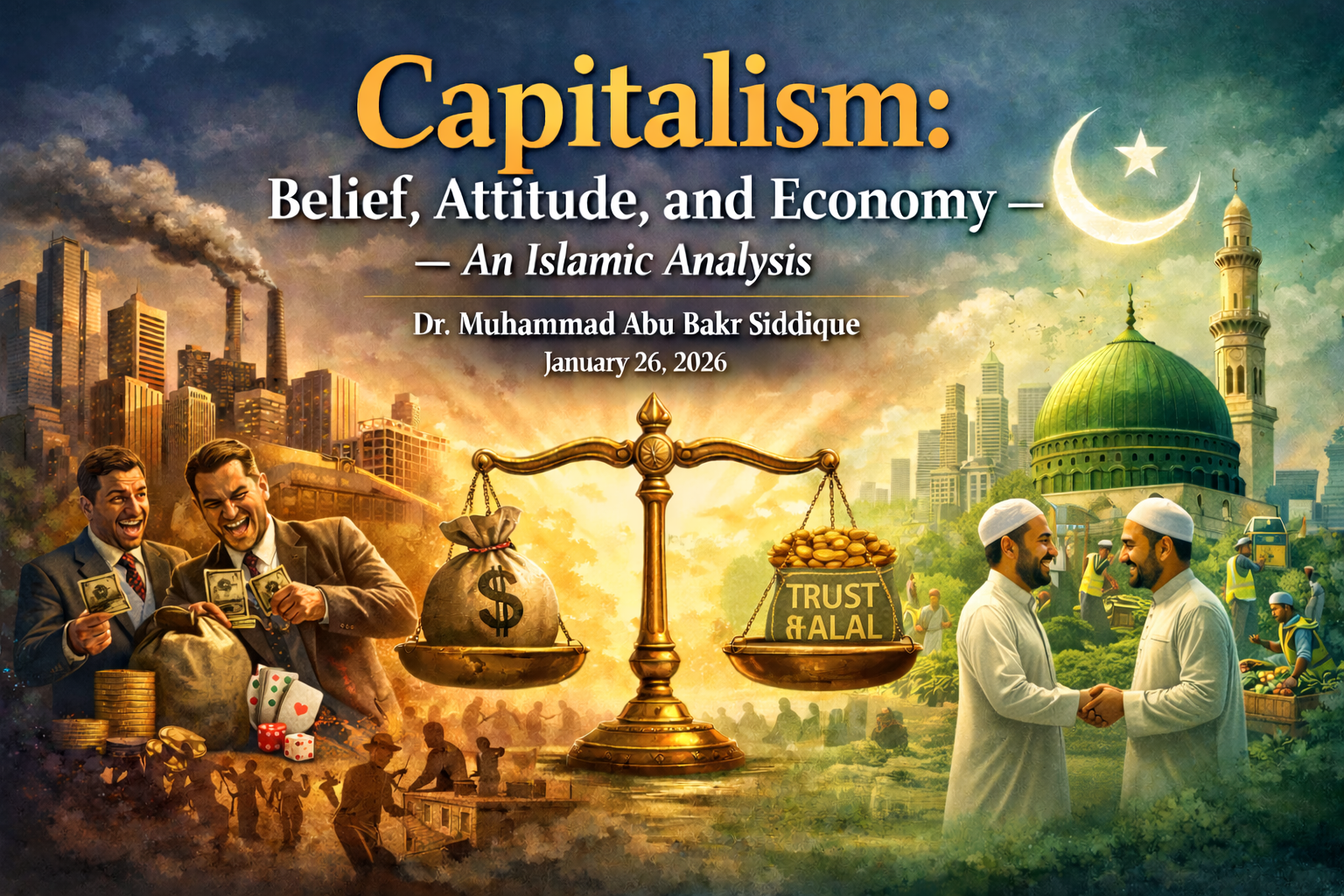
In the Capitalist paradigm, the objective of life for an individual or firm is reduced to profit maximization. The system operates on the principle that more profit is always the ultimate goal, justifying any means necessary to achieve it, provided it is legally permissible (and often, even legally grey areas are exploited).
-
In the Islamic paradigm, the objective of life is the Will of God (pleasing Allah through worship and righteous conduct). Economic activity, including profit earning, is merely a means to achieve this higher objective—to live a dignified life, fulfill obligations, and contribute to society. Therefore, Islam does not allow profit at any cost; it places strict moral and ethical constraints on how wealth is earned, invested, and spent, prohibiting interest (riba), gambling (maysir), fraud, hoarding, and trade in harmful goods.
Capitalism and Communism seem like opposites, but they share the same core goal: fulfilling human desires as much as possible. Capitalism favors the desires of the rich owner; communism favors the desires of the worker. But in both, the standard of right and wrong is human desire, not God’s guidance.
(6)The Economic Problem and Its Assumptions
Modern economics starts with this problem:
“Human wants are unlimited, but resources are limited.”
To solve it, they assume:
-
Religion has no role in economics.
-
People are naturally selfish (self-interested). This defines the “economic agent”—be it a producer, consumer, or government—as a rational, self-interest maximizer.
-
The goal is maximum profit and pleasure.
These ideas have dangerous effects. When there is no fear of the Hereafter and no moral accountability, people will do anything for profit—lie, cheat, exploit, or harm others.
(7) A Contrast in Human Nature: Selfish vs. God-Conscious
This leads to the second major contrast in the nature of the economic actor:
-
In the Capitalistic paradigm, the ideal economic agent is selfish (self-interest oriented). The system is designed expecting and encouraging this behavior, believing it leads to efficient markets.
-
In the Islamic paradigm, the ideal economic agent is God-fearing (muttaqi). Producers, consumers, and rulers are all expected to be conscious of Allah in every transaction. Self-interest is balanced and purified by the fear of God and accountability in the Hereafter, leading to fairness, charity, and restraint.
(8) Demand and Supply: A Materialistic View
Capitalism presents “demand and supply” as a universal law. But it only works fully in societies where fulfilling desire is the goal of life. In an Islamic society, something forbidden (haram) — no matter how cheap — will not have demand, because the God-fearing consumer and the God-conscious producer are both restrained by divine law.
In Capitalism, new desires are constantly created through advertising, media, and culture. People are made to want things they never needed, just to keep the economy growing.
(9) The Mix of Human Rights and Economics
When Human Rights (based on absolute freedom) met Capitalist economics (based on profit maximization), something dangerous happened. Industries of sin—pornography, gambling, prostitution, alcohol—became legal, profitable businesses. Investing in them is called “smart investment,” and earning from them is considered normal. To supply these industries, crimes like human trafficking also grew. This is the logical outcome of a system with no higher moral objective beyond profit.
(10) The Tragedy of Muslim Societies Today
Muslim countries are stuck in the middle. They do not fully follow Islam, and they do not fully accept Capitalism’s beliefs either. The result is confusion and failure. They want Islamic identity but adopt Western systems. This contradiction leads to:
-
Greed and hoarding (prioritizing profit over piety)
-
Fraud and corruption (the “selfish agent” mindset)
-
Sexual immorality (from imported “rights”)
-
Breakdown of the family
The Quran describes this condition beautifully:
“Wavering in between, belonging neither to these nor to those.” (Quran 4:143)
(11) Conclusion: The Way Forward
Honor, success, and peace will not come from a mixed, contradictory path. They will only come from returning fully to Islam as a complete way of life—in belief, worship, economy, and society. This means rejecting the profit-at-any-cost motive and nurturing God-consciousness in all economic roles.
Until our systems—government, economy, education—are based on the Quran and Sunnah, and our economic agents strive to be God-fearing rather than merely self-interested, Muslims will neither be true Muslims nor successful nations in this world.
O pace of the world, turn back towards the era of the Prophet (PBUH)
For my backwardness, evolution is needed again.