IslamicFina Public Awareness Reading Guide · Updated October 2026
Islamic Banking & Role of State Bank of Pakistan
Historical Development · Core Principles · Islamic Banking Products · Shariah Governance · SBP Regulation · Recent Developments
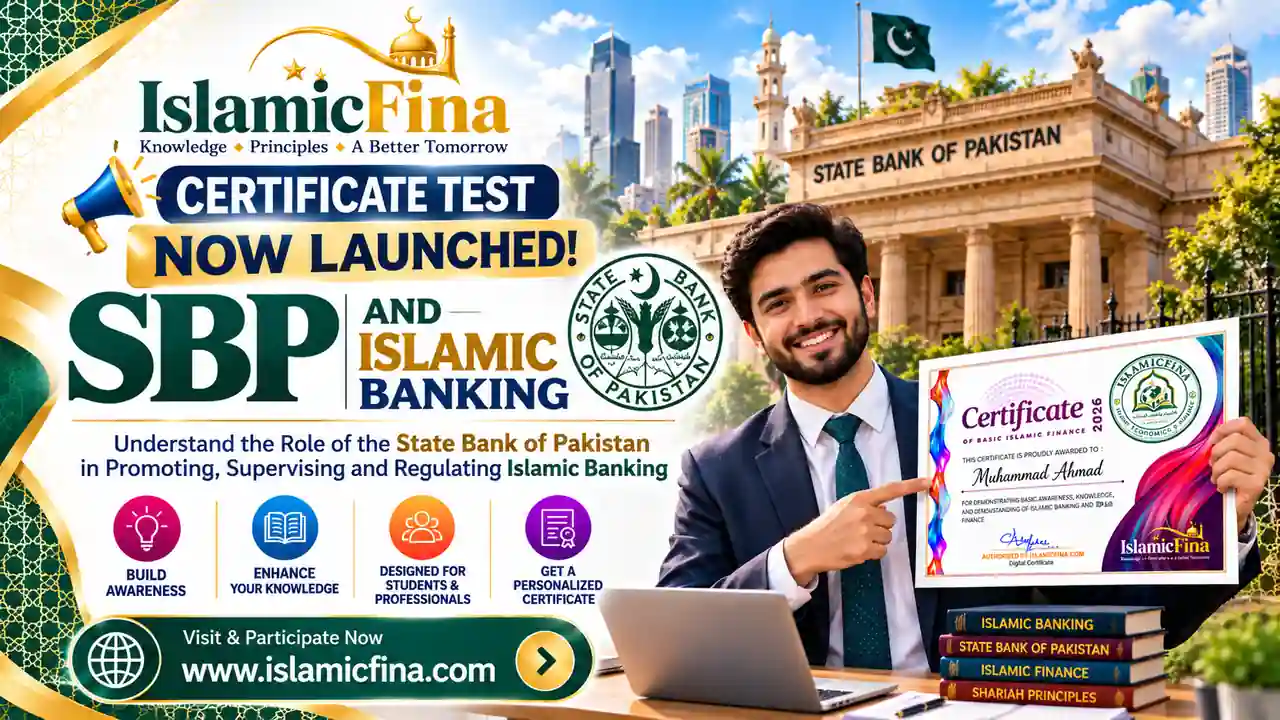
Prepare for the IslamicFina Certificate of Basic Islamic Banking Awareness (2026) with this essential reading guide. The certificate quiz link is provided at the end of the essay.
اردو میں پڑھنے کے لیے: پاکستان میں اسلامی بینکاری — مکمل اردو مضمون
Dr. Muhammad Abubakar Siddique
Islamic Financial Analyst | SECP Certified Shariah Advisor | Islamic Finance Executive Trainer | Islamic Finance Policy Expert
Introduction
Islamic banking has become an important part of Pakistan’s financial system. It offers banking services based on Islamic principles, particularly the prohibition of Riba (interest on loans), while allowing legitimate commercial activities such as trade, leasing, investment and partnership.Many people associate Islamic banking simply with interest-free banking. However, Islamic banking is a broader financial system based on specific contractual principles, the responsibilities of parties, and the sharing or allocation of commercial risks.
To understand Islamic banking in Pakistan, it is useful to examine three fundamental questions:
-
- How does Islamic banking differ from conventional banking?
- How did it develop in Pakistan? And
- what role does the State Bank of Pakistan play in its regulation, supervision and future development?
This article explains these matters in accessible language and introduces the major Islamic banking products and the industry’s development up to June 2026.
1. What Is Islamic Banking?
Islamic banking is a system of banking in which financial transactions must comply with Islamic Shariah principles.The most important distinction between Islamic and conventional banking concerns the contractual basis of financing and the manner in which banks earn income.
In conventional banking, lending money against interest is a major financing activity. Islamic banks, by contrast, cannot earn interest on loans. They may earn income through permissible commercial arrangements, including the sale and purchase of assets, leasing and investment activities.
For example, a conventional bank may lend money to a customer and charge interest. An Islamic bank may instead purchase an identified asset and sell it to the customer at an agreed profit, subject to the requirements of a valid sale.
Islamic banking does not prohibit earning profit; it prohibits earning Riba and other forms of income that violate Shariah principles.
Islamic banks must also avoid prohibited transactions involving excessive uncertainty (Gharar), gambling (Maysir), and impermissible goods or activities.
2. How Islamic Banking Differs from Conventional Banking
Both Islamic and conventional banks offer services such as deposits, financing, payments and fund transfers. However, the contractual principles governing their activities differ.
| Conventional banking | Islamic banking |
|---|---|
| May charge interest on loans | Cannot charge Riba on loans |
| Lending is a major financing mechanism | Uses Shariah-compliant sale, lease, partnership and other contracts |
| Interest may be agreed on deposits | Investment returns depend on the applicable Shariah contract |
| Subject to banking regulations | Subject to banking regulations and Shariah governance requirements |
| Can provide digital banking | Can also provide digital banking |
Islamic banks are commercial institutions. They may earn profits, incur losses and face business risks. Islamic banking does not guarantee that every financing or investment activity will generate a profit.
3. The Development of Islamic Banking in Pakistan: A Historical Overview
Pakistan’s journey toward Islamic banking has involved several phases of policy development, banking reforms, judicial decisions and regulatory initiatives.
1980s — Early interest-free banking reforms. Pakistan introduced significant measures aimed at reducing reliance on interest-based banking.
2001 — Renewed Islamic banking initiative. Pakistan began a renewed approach allowing dedicated Islamic banking institutions to develop alongside conventional banks.
2002 — First full-fledged Islamic commercial bank. Meezan Bank commenced operations under the renewed regulatory framework.
April 28, 2022 — Federal Shariat Court judgment. The Court ruled against Riba and set the end of 2027 as the target for eliminating the interest-based system.
June 28, 2024 — SBP conversion guidelines. SBP issued guidelines to help conventional banks plan their transition toward Islamic banking.
October 21, 2024 — 26th Constitutional Amendment. Article 38(f) was amended to require the complete elimination of Riba before January 1, 2028.
January 1, 2025 — Revised Shariah Governance Framework. SBP’s revised framework became effective, strengthening Shariah governance arrangements.
June 2026 — Continued expansion. Islamic banking institutions reported substantial growth in assets, deposits, financing and investments.
Why did Pakistan adopt a parallel banking approach?
The renewed Islamic banking initiative did not require all conventional banks to close immediately. Instead, Islamic banking institutions were allowed to operate alongside conventional banks. This created opportunities for full-fledged Islamic banks and for conventional banks to introduce dedicated Islamic banking operations under regulatory approval.
The objective was to expand access to Shariah-compliant services while allowing the industry to develop expertise, products, infrastructure and governance systems.
4. Pakistan’s Financial System and Its Regulators
Pakistan’s financial system includes banking institutions and non-banking financial institutions.State Bank of Pakistan (SBP): The central bank responsible for regulating and supervising banks, including Islamic commercial banks and the Islamic banking operations of conventional banks.
Securities and Exchange Commission of Pakistan (SECP): The regulator responsible for non-banking financial companies and various capital-market activities, including relevant Islamic financial institutions and products within its jurisdiction.
Thus, Islamic banking institutions are supervised by SBP, while Islamic non-banking financial institutions generally fall under the applicable SECP regulatory framework.
5. Types of Islamic Banking Institutions in Pakistan
Islamic banking services may be offered through different institutional and operational arrangements.A full-fledged Islamic bank conducts its banking operations according to Shariah principles.
A conventional bank with Islamic banking branches operates dedicated Islamic banking branches under the regulatory requirements applicable to those operations.
An Islamic banking window is an arrangement through which permitted Shariah-compliant services are offered within an institution, subject to the relevant regulatory framework.
Islamic digital banks provide banking services primarily through digital channels rather than relying on a conventional branch network.
Islamic microfinance arrangements are intended to provide smaller-scale financial services to individuals and businesses, particularly underserved customers. These arrangements are not all identical legal licensing categories.
Islamic banks operating in Pakistan as of June 2026
According to the June 2026 industry figures used for this guide, Pakistan had seven full-fledged Islamic banks, including one Islamic digital bank. The six established full-fledged Islamic banks were Meezan Bank Limited, BankIslami Pakistan Limited, Dubai Islamic Bank Pakistan Limited, Al Baraka Bank (Pakistan) Limited, MCB Islamic Bank Limited and Faysal Bank Limited.
The seventh was Raqami Islamic Digital Bank Limited, representing the emergence of a fully Islamic digital banking institution.
In addition, 16 conventional banks, including Mashreq Bank Pakistan Limited, were reported as offering Shariah-compliant banking services.
6. The Role of the State Bank of Pakistan in Islamic Banking
The State Bank of Pakistan plays a central role in developing, promoting, regulating and supervising Islamic banking.Its responsibilities include licensing banking institutions, establishing prudential requirements, issuing regulatory instructions, monitoring financial soundness and promoting compliance with applicable Shariah governance requirements.
Shariah governance and supervision
Islamic banks are not supervised solely by their own Shariah Boards. They are also subject to SBP’s regulatory and supervisory authority.
A bank’s Shariah Board oversees the Shariah compliance of its banking products, contracts and operations. Its work is supported by internal Shariah compliance, review and audit arrangements. SBP also has a Shariah Advisory Committee that provides guidance on Shariah matters relevant to Islamic banking policy and regulation.
The revised Shariah Governance Framework, effective January 1, 2025, was introduced to strengthen governance and promote greater consistency in Shariah compliance.
Strategic planning and conversion
SBP’s Vision 2028 identifies the transformation of banking toward Shariah compliance as an important strategic objective. In June 2024, SBP issued broad guidelines to help conventional banks develop conversion plans. These address strategy, governance, business operations, staff training, customer communication and transition milestones.
Conversion involves much more than changing product names: it requires changes in contracts, operations, systems, governance and staff capabilities.
Islamic Banking Bulletins
SBP regularly publishes Islamic Banking Bulletins reporting assets, deposits, financing, investments and banking network developments. These are important resources for understanding industry growth and performance.
7. Islamic Banking Accounts: Current, Savings and Investment Accounts
When a customer visits an Islamic bank to open an account, the underlying Shariah contract matters.
Current accounts
Islamic banks generally open current accounts on the basis of Qard, or a loan. Under this arrangement, the customer is the lender or creditor, while the Islamic bank is the borrower or debtor.
The bank must repay the full deposited amount when it becomes payable. The customer does not receive profit on this deposit because an agreed financial benefit on a loan would raise the issue of Riba.
Savings and investment accounts
Islamic banks commonly open savings and investment accounts on the basis of Mudarabah. The depositor provides investment capital and is called Rabb al-Mal. The bank manages the investment and acts as Mudarib.
Profits are distributed according to a pre-agreed profit-sharing ratio rather than a guaranteed interest rate. Genuine financial losses are generally borne by the capital provider in proportion to the capital invested, unless the loss results from the bank’s negligence, misconduct or breach of contractual obligations.
These principles explain why Islamic current accounts and Islamic investment accounts have different contractual foundations.
8. Major Islamic Banking Financing Contracts
Islamic banks use several Shariah-compliant contracts to meet customers’ financing needs.
Murabahah — Cost-plus-profit sale
Murabahah is a sale in which the seller discloses the cost of an asset and the agreed profit. For example, an Islamic bank may purchase machinery for PKR 1 million and sell it to a customer for PKR 1.1 million on deferred payment. The additional PKR 100,000 represents disclosed sale profit, provided the transaction meets Shariah requirements.
Ijarah — Leasing
Ijarah is a leasing arrangement in which the owner transfers the right to use an asset to another party for agreed rent. An Islamic bank may lease equipment or a vehicle to a customer.
Musharakah — Partnership
Musharakah is a partnership in which two or more parties contribute capital to a business or investment. Profits are shared according to an agreed ratio, while financial losses are borne according to capital contributions.
Diminishing Musharakah — Gradual transfer of ownership
Diminishing Musharakah is commonly used in home financing. The bank and customer jointly own an asset. Over time, the customer purchases the bank’s ownership share until becoming the sole owner.
Mudarabah — Capital and management partnership
Mudarabah involves one party providing investment capital and another managing the business. The capital provider is called Rabb al-Mal and the manager is called Mudarib. The manager is not ordinarily required to contribute an equal amount of capital.
Salam — Advance payment for future delivery
Salam is a sale in which the full price is paid in advance for specified goods delivered later. It can be useful for financing agricultural production and other eligible goods.
Istisna — Manufacturing or construction
Istisna is a contract for manufacturing or constructing an asset according to agreed specifications, such as specialized machinery or a building.
Islamic banking financing is not limited to partnership contracts. Sale, lease, manufacturing and other permissible structures also play important roles.
9. Growth of Islamic Banking in Pakistan: June 2026
ISLAMIC BANKING INDUSTRY — JUNE 2026
QoQ means quarter-on-quarter growth, comparing June 2026 with March 2026.
Growth during April–June 2026
Quarter-on-quarter percentage growth
Scale: 0–13% | Source: SBP Islamic Banking Bulletin, June 2026
During April–June 2026, total Islamic banking assets increased by PKR 1,686 billion, while deposits increased by PKR 1,370 billion.
These figures show substantial growth in the size and activity of the Islamic banking industry. Nevertheless, Islamic banking still represented less than half of Pakistan’s total banking assets.
The industry’s expansion reflects growing demand for Shariah-compliant financial services and continued development of Islamic banking institutions.
For more information, see the SBP Islamic Banking Bulletin — June 2026.
10. Digital Banking and Financial Inclusion
Modern Islamic banking is not restricted to physical branches. Islamic banks can provide services through mobile applications, internet banking, digital payments and other electronic channels, subject to applicable regulations.The emergence of Islamic digital banking in Pakistan demonstrates that Shariah-compliant banking and financial technology can operate together.
Digital banking may also contribute to financial inclusion: making suitable financial services accessible to a wider population, including individuals, small businesses and communities with limited access to physical bank branches.
Financial inclusion is not merely about increasing account numbers. It also involves improving access to payments, savings, financing and other appropriate financial services.
11. The Future of Islamic Banking in Pakistan
The future of Islamic banking in Pakistan is influenced by regulatory policy, constitutional commitments, customer demand and operational capabilities.The Federal Shariat Court’s judgment of April 28, 2022, and the 26th Constitutional Amendment of October 21, 2024, have given particular importance to the objective of eliminating Riba from Pakistan’s financial system. The constitutional requirement is to eliminate Riba completely before January 1, 2028.
Achieving this objective involves practical challenges, including converting products and contracts, developing suitable investment and liquidity-management instruments, strengthening Shariah governance, training professionals and maintaining financial stability.
SBP’s strategic initiatives, conversion guidelines and governance requirements form part of this transition. Public understanding is equally essential: customers should know how contracts work, what risks they involve and how Islamic banking differs from conventional interest-based financing.
Conclusion
Islamic banking in Pakistan has evolved from early interest-free banking reforms into a significant and growing component of the national financial system.Its development has been shaped by regulatory initiatives, the establishment of Islamic banks, judicial decisions, constitutional amendments and increasing public demand for Shariah-compliant services.
SBP plays a central role in licensing, supervising, regulating and promoting Islamic banking, while SECP supervises relevant non-banking financial institutions and capital-market activities.
Understanding Islamic banking requires more than knowing that interest is prohibited. It also requires familiarity with Islamic banking accounts, financing contracts, Shariah governance, financial regulation and the industry’s development. With this knowledge, readers can make better-informed financial decisions and participate more meaningfully in discussions about the future of Islamic banking in Pakistan.
Ready to Test Your Knowledge?
This article provides foundational knowledge for the IslamicFina Certificate of Basic Islamic Banking Awareness (2026). After reading, visitors can attempt the 50-question certificate examination covering Islamic banking principles, Pakistan’s Islamic banking history, SBP’s regulatory role, Islamic banking products and recent industry developments.
Take the IslamicFina Certificate Quiz
Source: State Bank of Pakistan — Islamic Banking Bulletin (June 2026).