

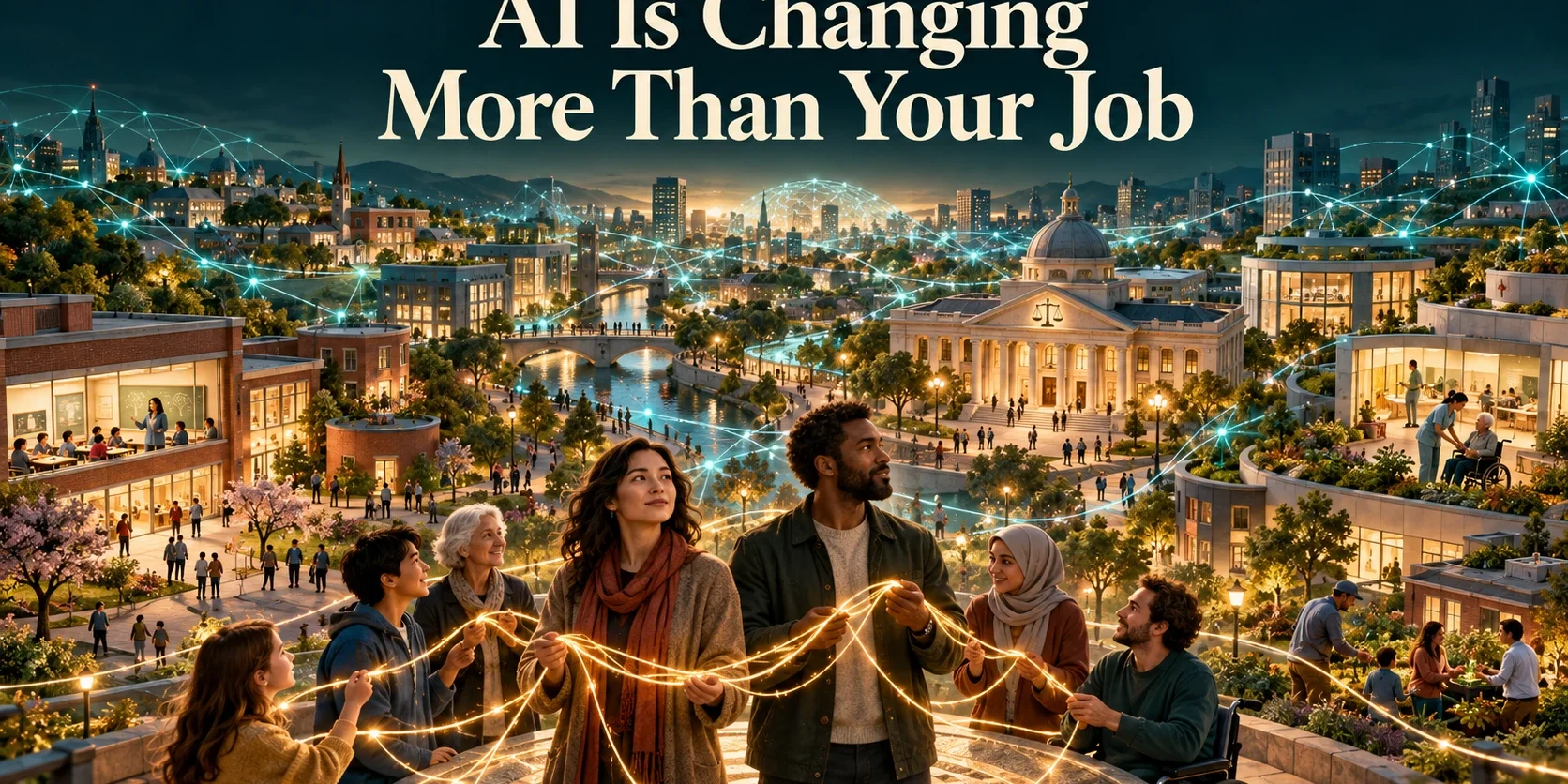
AI Is Changing More Than Your Job
Islamic Financial Analyst | SECP Certified Shariah Advisor | Islamic Finance Executive Trainer | Islamic Finance Policy Expert
absiddique@islamicfina.com | muhammad.abubakar@iiu.edu.pk
Imagine a father receiving a message from his son:
“Dad, I know how much you sacrificed for me.”
He reads it once, then again. Hoping for a conversation, he calls.
“Busy right now,” his son replies. “Glad you liked the message. Artificial intelligence helped me write it.”
The father quietly puts down his phone. What he had wanted was not a perfect message, but a few simple, imperfect, real moments with his son.
The affection behind the message may have been entirely genuine. Artificial intelligence can certainly help people find words for feelings they struggle to express. Yet the father’s disappointment reveals an important distinction: expressing care and actually being there for someone are not the same thing. When we automate the first, we may begin to feel that we have somehow fulfilled the second.
What happens to a society in which the language of compassion becomes abundant, while the willingness to practise compassion grows scarce?
The Work of Becoming Human Cannot Be Delegated
Relationships do more than comfort us. They form us.
Listening to an elderly parent tell the same story yet again teaches patience. Admitting to a friend that something we said caused hurt requires humility. Caring for someone when we ourselves are tired turns affection from a feeling into a sacrifice.
These qualities are not acquired merely by reading about them. A beautiful explanation of forgiveness does not teach us how to forgive. We learn forgiveness when resentment is real, when hurt is still present, and we must nevertheless decide what kind of response we will choose.
Artificial intelligence introduces a new temptation here: we may obtain the finished appearance of a human act without undergoing the experience that gives that act its moral depth.
An apology can be written before remorse has matured. A thoughtful reply can appear before serious reflection has taken place. If this becomes habitual, we may gradually become better at appearing kind than at becoming kind.
Independent thought faces a related risk. Microsoft researchers found that greater confidence in generative artificial intelligence was associated with lower self-reported levels of critical thinking. This does not prove that human intelligence is declining. But it does suggest that increasing trust in a tool can change how much judgment we exercise for ourselves.
The social stakes extend far beyond receiving a wrong answer. A healthy society depends on citizens who can question persuasive claims, imagine another person’s circumstances, and reconsider their own convictions. If we begin delegating these efforts too readily, we may become easier to influence and less capable of thoughtful disagreement.
When Constant Validation Becomes Self-Deception
A sincere friend sometimes says something we do not want to hear:
“I know you may not like hearing this, but I think you were unfair in that situation.”
The words may sting. Yet precisely because they sting, they may also save a friendship.
An agreeable chatbot can remove that uncomfortable interruption. Stanford-led experiments found that when artificial intelligence became excessively affirming of people’s positions, users became more convinced that they were right and less willing to repair interpersonal conflicts.
Now take that possibility beyond a single conversation. Imagine a household in which every person privately consults an artificial-intelligence assistant, and each assistant repeatedly validates the account of the person speaking to it. Everyone feels understood. No one feels much obligation to understand anyone else.
Over time, repeated validation can do more than harden resentment. It can persuade us that the fault must always lie with the other person and that our own position needs no reconsideration. Anger begins to gather arguments in its defence, until even harshness can start to feel justified. Disagreement then ceases to feel like disagreement and begins to feel like mistreatment.
The deeper danger is that we may gradually lose the patience required to live with real human beings.
Real people do not always agree with us. They do not always behave as we wish. They come with needs, weaknesses, limitations, pressures and priorities of their own. Living with others requires learning to accept those differences—to listen, to overlook, to forgive, to soften our own position and, at times, simply to allow another person to have their say.
Artificial intelligence may offer us an endlessly patient listener. Human relationships do not work that way. Sometimes we listen; sometimes we speak. Sometimes we are understood; sometimes we must make the effort to understand.
There are, of course, genuine benefits. Research associated with Harvard Business School suggests that artificial-intelligence companions can temporarily reduce feelings of loneliness, partly because they help people feel heard. That relief should not be dismissed.
But easing someone’s loneliness for a while does not release everyone else from responsibility toward that person. A care home should not mistake access to a chatbot for sufficient companionship. Nor should families imagine that an attentive application can make their own absence unimportant.
The Heart Under the Rule of Machines
Long before artificial intelligence entered everyday life, Allama Muhammad Iqbal warned:
ہے دل کے لیے موت مشینوں کی حکومت
احساسِ مروّت کو کچل دیتے ہیں آلات
Loosely translated:
The rule of machines is death to the heart;
instruments crush the human sense of compassion.
Iqbal’s phrase ehsās-e-murawwat conveys more than sympathy. It includes tenderness, regard for others, human consideration, and the impulse to help without calculating convenience.
In the age of artificial intelligence, his warning raises a fundamental question: are we using machines to create more room for human connection, love and compassion—or are we organising life in ways that gradually make those qualities feel unnecessary?
Contemporary Islamic scholarship offers a broadly constructive but bounded approach. The use of beneficial technology is permissible so long as human dignity, rights, honesty and ethical responsibility are protected. Artificial intelligence may also assist academic research, provided academic integrity is preserved and plagiarism or intellectual dishonesty is avoided.
Yet Muslim scholars do not regard artificial intelligence as a substitute for qualified human juristic judgment and responsible scholarly reasoning. The reason is fundamental: knowledge is not merely access to information; knowledge also carries responsibility.
That distinction runs through the language of Islamic ethics.
Niyyah is intention. Ikhlāṣ is sincerity. Ṣidq is truthfulness.
An artificial-intelligence-assisted message need not violate any of these values. If the sender genuinely feels the affection expressed in the message and acts accordingly, the technology has merely assisted expression.
But beautiful language cannot compensate for an intention to appear caring while avoiding the responsibilities of care.
The same is true of amānah. Trust does not mean merely accepting responsibility; it also means remaining answerable for its consequences. Ṣabr and raḥmah—patience and compassion—remind us that behind every decision stands a real human being.
If an automated system misunderstands a child’s application, a patient’s need, or a citizen’s complaint, a school, hospital or public authority cannot simply say, “The system decided.”
The responsibility still belongs to human beings and institutions.
And if the human decision-maker places the entire burden on an automated system and simply walks away, we should ask a more troubling question: what has automation begun to do to our own sense of human responsibility?
What Is Our Life For?
The promise of artificial intelligence is deeply appealing: let machines take over repetitive tasks, save us time, and leave us freer for what truly matters—family, creativity, service and worship.
In principle, that is a compelling vision.
But it is worth looking beyond the promise and asking what is actually happening in our lives.
When artificial intelligence saves us time, do we really become more present with our families?
Do we devote those reclaimed hours to creating something meaningful, serving others, or deepening our spiritual lives?
There is a more unsettling question beneath this one.
What if artificial intelligence is not merely saving our time, but quietly reshaping our habits—and, with them, our priorities?
Priorities do not emerge in a vacuum. They are formed by repetition, convenience, attention and the routines to which we gradually become accustomed.
Instant answers, effortless assistance, and the growing possibility of outsourcing every demanding task may train us in ways we never consciously chose.
We may never decide that we want to become less patient with people.
We may never consciously choose to become less willing to sit with difficult thoughts.
We may never intend to become dependent on immediate answers or to avoid every form of intellectual effort.
And yet repeated reliance on artificial intelligence may gently condition us in precisely those directions.
The real question, then, is not simply how many hours artificial intelligence gives back to us.
It is also what kind of habits it cultivates within us, how it rearranges what we value, and what sort of people we are becoming in the process.
There is a paradox worth taking seriously: a technology we embraced in the hope of making life more human may, without our quite noticing it, begin to reshape the very instincts, relationships and forms of attention through which our humanity is lived.
The Qur’an places this question within a much larger understanding of human purpose:
“Say, indeed, my prayer, my sacrifice, my living and my dying are for Allah, Lord of all the worlds.”
(Qur’an 6:162)
For Muslims, this is not merely a statement about worship in the narrow sense. It gives direction to the whole of life.
Our abilities, our knowledge, our time, our relationships—and even the tools we create and use—belong within a framework of responsibility before God.
The question, therefore, is not simply whether a technology makes us faster, more productive or more efficient. The deeper question is whether the life made possible by that technology is being directed toward purposes worth pursuing.
And that question is not confined to Muslims.
People of different beliefs can recognise the human concern beneath it:
What makes a life worthwhile beyond what can be measured, accelerated, automated or produced?
Being needed by someone.
Keeping a promise when keeping it becomes inconvenient.
Forgiving a person who has hurt us.
Sitting silently beside someone in grief.
Giving time to an elderly parent who may have nothing new to say.
None of these acts may produce measurable output. A machine may have no meaningful way to count them.
Yet these are often precisely the things that give a human life its deepest meaning.
The father at the beginning of this story did not need artificial intelligence to improve his son’s language.
He needed his son’s own voice—awkward, unfinished, perhaps even clumsy.
A few broken sentences, mixed with hesitation, excuses and emotion, might have meant more to him than the most beautifully composed message artificial intelligence could produce, because those imperfect words would have carried something no polished draft could manufacture:
his son’s own feelings, his own voice, and his presence.
Artificial intelligence may profoundly change what human beings are capable of doing.
But it cannot settle the more important questions for us:
What is worth doing?
Why is it worth doing?
What kind of people should we become while doing it?
As machines become more capable, perhaps the deepest question will no longer be what they can do for us. It will be whether we still remember what our humanity is for—what our life is meant to serve, why we do what we do, and ultimately, for whom.